Mirax Casino Licence and Trust in Australia: Curaçao, ACMA and Player Context
 Available in US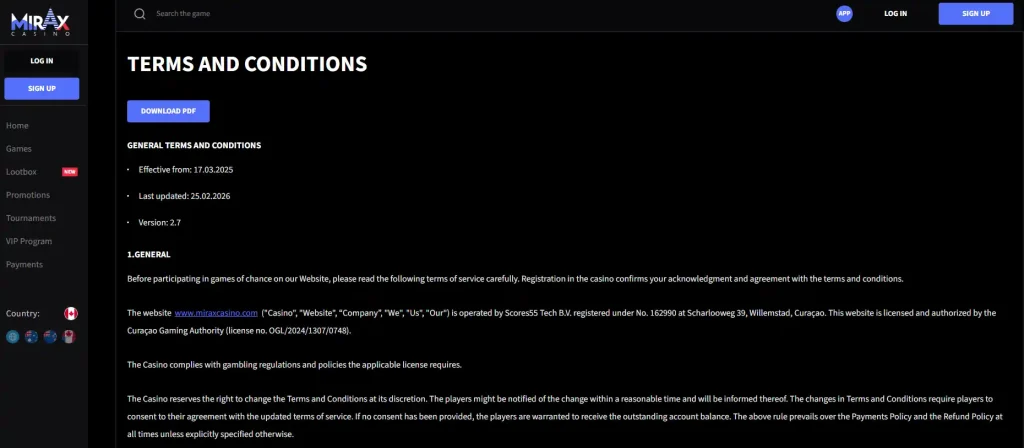
Mirax Casino is operated by Scores55 Tech B.V., registration no. 162990, and its current official Terms state Curaçao Gaming Authority licence OGL/2024/1307/0748. That is a Curaçao licence, not an Australian gambling licence. For an Australian reader, the distinction is central: ACMA states that the Interactive Gambling Act 2001 makes it illegal for providers to offer online casino services to people in Australia.
This does not support a simplistic label that Mirax is “Australian licensed”, nor does it justify turning a provider-side prohibition into a blanket statement that an individual Australian player necessarily commits an offence by accessing a site. The useful trust analysis is jurisdiction by jurisdiction: who operates Mirax, what its Curaçao authorisation covers, what Australian law restricts on the provider side, and which local protection schemes do or do not apply.
Table of Contents
- Who operates and licenses Mirax
- What the Curaçao licence does – and does not – tell an Australian reader
- Australian law: provider-side prohibition for online casinos
- ACMA is the key federal regulator in this context
- Website blocking is an enforcement tool, not a licensing test
- The 2026 reforms: passed now, mostly commencing in 2027
- BetStop does not function as a general offshore-casino protection scheme
- Mirax responsible-gambling tools are separate from Australian protection
- What “trust” should mean in practice
- Complaints need context, not anecdotes
- A jurisdiction-aware checklist before using Mirax
- Current regulatory position
- Check current regulatory information
- Mirax Casino Licence and Trust in Australia: Curaçao, ACMA and Player Context
Who operates and licenses Mirax
Mirax’s official Terms, last updated 25 February 2026, identify Scores55 Tech B.V. as the operator and give company registration no. 162990. The same Terms state that the website is licensed and authorised by the Curaçao Gaming Authority under licence OGL/2024/1307/0748. The Mirax homepage repeats the operator and licence information.
The current Mirax Terms identify the operator and specific licence number.
The licence should be described precisely as Curaçao authorisation. It should not be reworded as ACMA approval, an Australian licence or Australian consumer-protection membership.
What the Curaçao licence does – and does not – tell an Australian reader
A gambling licence places an operator under the rules of the licensing jurisdiction named in that licence. In Mirax’s case, the published jurisdiction is Curaçao. That is relevant when checking operator identity, the authorisation framework and the terms under which the site says it operates.
It does not answer whether the same casino service is authorised to be provided to customers in every other country. Gambling regulation is territorial. A Curaçao licence does not transform into an Australian licence because the site supports AUD, can be reached from an Australian connection or lists Australia outside its own general restricted-country list.
This is why the trust question should not be reduced to “licensed or unlicensed”. The better sequence is: identify the licence, identify the operator, then check the law and regulator relevant to the reader’s location. For Australia, that means ACMA and the Interactive Gambling Act.
Australian law: provider-side prohibition for online casinos
ACMA’s current guidance says the Interactive Gambling Act 2001 sets rules for companies that offer or advertise gambling services, including gambling through websites and apps. ACMA states that the Act makes it illegal for gambling providers to offer some online services to people in Australia and specifically lists online casinos among the banned services.
The legislation is framed around provision of a prohibited interactive gambling service with an Australian-customer link. Section 15 includes offence and civil-penalty provisions for a person who provides such a service where customers are physically present in Australia. The wording therefore focuses on provider obligations rather than making a blanket claim about criminal liability for an individual player.
For due diligence, the practical point is still significant: a foreign licence is not a substitute for Australian authorisation, and the fact that a casino accepts an account or displays AUD does not override the federal provider rules.
ACMA is the key federal regulator in this context
The Australian Communications and Media Authority administers the federal online-gambling framework discussed here. Its online gambling guidance separates licensed interactive wagering services from prohibited services such as online casinos. This distinction is important because “online gambling” covers different products, and the licensing position for wagering cannot be casually transferred to casino games.
ACMA also investigates suspected breaches, issues enforcement action and uses disruption measures. Its compliance reporting for April to June 2026 recorded 30 investigations into 76 gambling sites, 56 breaches of the Interactive Gambling Act and 187 websites referred for blocking. Those figures show an active enforcement environment, but they do not prove that Mirax itself was included in that particular list.
There is no documented basis here to say that ACMA has licensed or endorsed Mirax, or made a specific enforcement finding about it, without a direct Mirax entry.
Website blocking is an enforcement tool, not a licensing test
ACMA can ask Australian internet service providers to block illegal gambling and affiliate websites. In June 2026, ACMA said that 1,751 illegal gambling and affiliate websites had been blocked since the first blocking request in November 2019, and that more than 230 illegal services had withdrawn from the Australian market since the 2017 enforcement changes.
Those numbers provide regulatory context, not a Mirax-specific status. The ACMA blocked-sites material checked did not identify Mirax by name, and absence from a blocking list is not approval. A site can also be reachable before, after or independently of enforcement action. Accessibility is therefore a technical observation, not a licence credential.
The same logic prevents the opposite error: a geoblock or failed page load by itself is not proof of an Australia-specific legal restriction unless the relevant rule explicitly identifies Australia and its scope.
The 2026 reforms: passed now, mostly commencing in 2027
ACMA’s guidance was updated after Parliament passed the Interactive Gambling Amendment (Gambling Reform) Bill 2026 on 19 August 2026. ACMA describes reforms covering gambling advertising, a global advertising opt-out register, restrictions on some inducement marketing, affiliate commissions, stronger enforcement tools and changes to BetStop.
Timing matters. ACMA states that most of these reforms commence on 1 January 2027. As of 10 September 2026, it would be misleading to write as though every measure is already in force. The current provider-side prohibition on online casinos is not dependent on those future commencement dates; it comes from the existing Interactive Gambling Act framework.
This distinction is an example of why current legal pages need dates. “Australia changed its gambling law in 2026” is too broad to help a reader decide what applies now versus from 2027.
BetStop does not function as a general offshore-casino protection scheme
BetStop is the National Self-Exclusion Register. ACMA explains that it lets a person exclude themselves from all Australian licensed online and phone wagering services in a single step. The phrase “Australian licensed” and the product category “wagering” matter here.
Mirax is presented in its own Terms as a Curaçao-licensed online casino, not an Australian licensed wagering provider. BetStop should not be assumed to cover Mirax or automatically block access to every offshore casino website. Its statutory service scope is narrower than a universal internet filter.
For people who want to stop or reduce gambling, the limited scope of a single tool is a reason to combine controls: use available self-exclusion or account limits, payment and device controls where appropriate, and Australian support services. The regulatory distinction should increase clarity, not become a reason to minimise harm.
Mirax responsible-gambling tools are separate from Australian protection
Mirax states that it provides account-level gambling limits and self-exclusion tools. Those features are relevant to a trust review because they give the account holder mechanisms to limit or stop play. They are still operator-side tools within the Mirax environment.
They should not be described as ACMA controls or as evidence that Australian consumer-protection schemes apply. A useful trust assessment asks both questions separately: what controls does the operator provide, and what external regulatory or dispute framework applies to the reader? Conflating the two overstates protection.
If gambling no longer feels controlled, the sensible decision is to stop play rather than use a licensing discussion as reassurance. ACMA’s guidance points to Australian support resources, including the National Gambling Helpline and Gambling Help Online.
What “trust” should mean in practice
No licence number can guarantee a particular withdrawal, dispute outcome or user experience. For practical due diligence, trust should be tested through observable and documentable points: operator identity, current terms, payment methods, KYC requirements, support access, responsible-gambling controls and the jurisdiction in which a complaint would need to be pursued.
Before depositing, save or read the terms that matter to the intended transaction. If a bonus is accepted, understand the current wagering and maximum-bet rules. If a withdrawal is planned, understand KYC and the published cashout framework. Use payment methods in your own name. Keep records of deposits, withdrawals and material support conversations.
The dedicated withdrawal rules page handles cashout limits, while bonus terms handles the promotion-specific conditions. Cashout limits and bonus conditions are covered separately because transaction mechanics and legal context are different questions.
Complaints need context, not anecdotes
One positive testimonial does not prove reliability, and one angry post does not prove misconduct. Complaint records need context: what happened, whether documentation exists, whether the operator responded, whether the dispute involved a published term, and whether an independent resolver reached a finding.
Detailed reputation analysis is covered separately on the complaints and reputation section. Before interpreting individual complaints, first establish the licensing and Australian regulatory framework. A Curaçao licence, Australian provider restrictions and the absence of Australian licensing are structural facts; user stories are a separate issue.
A jurisdiction-aware checklist before using Mirax
- Verify the operator and licence number against the current Mirax Terms rather than an old review.
- Recognise that the published licence is Curaçao Gaming Authority licence OGL/2024/1307/0748, not an Australian licence.
- Read ACMA’s current Interactive Gambling Act guidance for the Australian provider-side rules.
- Do not use AUD support or website accessibility as proof of local authorisation.
- Do not assume BetStop covers an offshore casino simply because it is a national self-exclusion register.
- Check payment, KYC and bonus terms that apply to the transaction you actually plan to make.
- Use responsible-gambling limits and self-exclusion tools when they are appropriate, while understanding their jurisdictional scope.
- Document unresolved account issues and review the complaints page before escalating a dispute.
This checklist is intentionally conservative about what each fact proves. The strongest trust decision comes from keeping licence, local law, account features and personal risk controls distinct.
Current regulatory position
Current records show that Mirax currently publishes a specific Curaçao Gaming Authority licence and operator identity. It also establishes that ACMA says providers must not offer online casino services to people in Australia under the Interactive Gambling Act framework. It can explain that most reforms passed on 19 August 2026 are scheduled to commence on 1 January 2027.
Those facts do not establish that Mirax is Australian licensed, ACMA approved or covered by Australian licensed-wagering protections. It also does not state that an individual Australian player necessarily commits an offence by visiting or using the site, because the primary material cited here is framed around provider obligations.
That distinction is more useful than a binary “safe/unsafe” badge because it shows which regulatory relationship is documented and which one is not.
Check current regulatory information
As of 10 September 2026, the Mirax Terms are marked version 2.7, last updated 25 February 2026. They identify Scores55 Tech B.V., registration no. 162990, and Curaçao Gaming Authority licence OGL/2024/1307/0748. ACMA’s Interactive Gambling Act overview, last updated 21 August 2026, continues to list online casinos as banned services for providers to offer to people in Australia.
ACMA’s current guidance also records the 19 August 2026 reform passage and says most measures commence on 1 January 2027. Because these are freshness-sensitive legal facts, they should be rechecked if relying on this information after 10 September 2026.
Return to the Mirax Australia review for the overall product view, or continue to player complaints and reputation for the separate evidence about dispute history.