Mirax Crypto Casino Payments in Australia: Coins, Deposits and Withdrawals
 Available in US
Mirax supports cryptocurrency payments and currently lists major assets including Bitcoin (BTC), Ethereum (ETH) and Tether (USDT), alongside Litecoin, Bitcoin Cash, XRP, Dogecoin, BNB, TRX and ADA in its public payment and currency information. AUD is also a supported account currency, so crypto support should not be confused with the currency in which an Australian player chooses to view or manage the casino balance.
For Australian readers, crypto is a genuine Mirax cashier feature but still a niche everyday payment behaviour. Reserve Bank of Australia research published in May 2026 found that only around 2% of respondents had used cryptocurrency to make a payment in the prior year. Crypto also does not change Australia’s rules for online casino providers. Treat it as a payment rail, not a regulatory workaround.
Table of Contents
- Which cryptocurrencies does Mirax support?
- Crypto support and AUD account currency are different layers
- Network matching is more important than the coin logo
- What Mirax currently publishes about crypto processing
- Depositing with crypto: a practical sequence
- Withdrawing to a wallet requires account verification too
- Crypto price and conversion risk
- Crypto is still uncommon as an Australian payment method
- Crypto does not change Australian online-casino regulation
- Who is crypto most suitable for?
- Check current information
- Mirax Casino Payment Methods in Australia: AUD, Cards, E-Wallets and Cashier Checks
Which cryptocurrencies does Mirax support?
Mirax lists a broad crypto set including BTC, BCH, LTC, ETH, XRP, DOGE, USDT, BNB, TRX and ADA. Its Payments page includes crypto rows for deposits and withdrawals, while the Terms list crypto codes among supported playing currencies.
The useful distinction is between an asset appearing in Mirax’s general payment information and a specific network or option appearing in one user’s cashier. Before moving funds, check the live cashier for the exact asset, network, minimum and destination instructions shown to the account.
| Crypto | Current information | What to check before sending |
|---|---|---|
| Bitcoin (BTC) | Listed by Mirax in its crypto payment/currency information. | Exact deposit address, network and minimum shown in the cashier. |
| Ethereum (ETH) | Listed by Mirax and currently shown in the public payment table. | Correct network and destination address. |
| Tether (USDT) | Listed by Mirax and currently shown in the public payment table. | The specific USDT network, because the asset name alone is not enough. |
| Other listed coins | LTC, BCH, XRP, DOGE, BNB, TRX and ADA are included in current Mirax materials. | Whether the exact coin and network remain enabled for the account. |
Crypto support and AUD account currency are different layers
Mirax supports AUD as an account currency. That fact is independent of whether a deposit arrives through a crypto rail. A user can therefore think about two values at once: the asset transferred into or out of the casino and the account currency used to display balances or wager values.
A crypto transaction can involve price movement or conversion even if the casino account itself is shown in AUD. Mirax does not publish a fixed exchange rate or universal conversion spread.
Before sending crypto, check the amount the cashier says will be credited and the currency in which the account will reflect it. For a broader comparison with cards, e-wallets and online banking, use the all payment methods page.
Network matching is more important than the coin logo
A common practical mistake is to verify the coin name but not the transfer network. USDT is the clearest example because the same asset can exist on multiple networks. A wallet address or network selection that does not match the casino’s current deposit instructions can create a failed or difficult-to-recover transfer.
The correct process is to open the Mirax cashier, select the crypto asset, read the network presented there, and copy the destination exactly. Then compare that network with the withdrawal network selected in the external wallet or exchange. Do not rely on an old review image, because supported networks and payment integrations can change.
The same caution applies when withdrawing. Confirm the destination wallet supports the exact network Mirax presents. A technically valid address is not enough if it belongs to a different chain or routing format.
What Mirax currently publishes about crypto processing
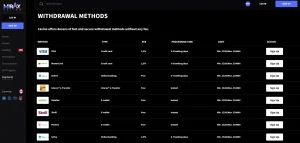
Mirax’s public Payments page currently shows several cryptocurrency rows with a fee label of “Free” and a processing label of “Instant”. It also publishes asset-specific minimums in the table. Those observations are useful because they come from Mirax’s own current payment page rather than a third-party casino review.
They still need to be interpreted correctly. A published “Instant” method label is not a guarantee of end-to-end withdrawal completion. Casino account review and KYC can occur before a withdrawal reaches the blockchain, and blockchain confirmation conditions can exist after release. For that reason, no exact end-to-end time from withdrawal request to wallet receipt is documented.
If payout speed is the main concern, the cashout rules section explains Mirax’s weekly and monthly caps, KYC role and the difference between account review and payment-rail processing.
Depositing with crypto: a practical sequence
- Confirm the crypto asset is currently offered in your Mirax cashier.
- Check the exact network rather than relying only on the coin symbol.
- Read the current minimum and any fee information shown for that method.
- Copy the deposit address carefully and compare the beginning and end of the address before sending.
- Confirm the sending wallet or exchange supports the same network.
- Consider a small first transfer when your own wallet practices and fee structure make that sensible.
- Keep the transaction identifier so you can distinguish a blockchain transfer issue from a casino-account issue.
This sequence is not unique to Mirax, but it becomes useful here because Mirax offers multiple crypto assets. More choice increases the need to verify asset and network details rather than treating “crypto” as one interchangeable method.
Withdrawing to a wallet requires account verification too
Crypto does not remove Mirax’s KYC requirements. The Terms describe KYC as obligatory and say failure to provide requested documents prevents payments. That applies to the account relationship, not only to traditional bank rails. A wallet withdrawal can therefore still depend on identity, address or payment evidence checks before funds are released.
Mirax also prohibits use of third-party payment systems. The practical implication is to use payment accounts and wallets that you control and can connect to your verified identity where required. Sending to a friend’s wallet or trying to route around account verification creates unnecessary ownership and compliance problems.
Detailed document requirements belong on the separate KYC page, while this crypto page stays focused on the payment decision itself.
Crypto price and conversion risk
Unlike an AUD bank balance, a cryptocurrency can move in market value between the moment it is acquired, deposited, withdrawn and later converted. Even when a casino payment fee is listed as zero, that does not mean the whole transaction is economically cost-free. A wallet or exchange can charge network or service fees, and the asset price can change.
There is no universal cost percentage because fees and conversion effects depend on the asset, network, wallet, exchange and market conditions. The decision question is whether the convenience of the supported crypto rail is worth accepting those extra variables compared with a fiat payment method.
For someone who already holds and understands crypto, the operational steps may be familiar. For someone buying crypto solely to fund a casino account, there are additional moving parts that do not exist with a straightforward AUD payment route.
Crypto is still uncommon as an Australian payment method
The Reserve Bank of Australia’s 2025 Consumer Payments Survey provides useful context. Its May 2026 analysis reported that awareness of cryptocurrency as a payment method remained high, but only around 2% of respondents said they had used crypto to make a payment in the previous year. The RBA described cryptocurrency as one of the least commonly used alternative payment methods in the survey.
That does not weaken the evidence that Mirax supports crypto. It simply prevents a misleading local-market claim. Mirax can offer many crypto rails while Australian consumers as a whole still use cryptocurrency rarely for everyday payments. Brand support and national adoption are separate facts.
Crypto does not change Australian online-casino regulation
Australia’s Interactive Gambling Act focuses on the gambling service being offered, not on whether payment is made by card, bank transfer or cryptocurrency. ACMA states that online casinos are among the services gambling providers are prohibited from offering to people in Australia. Paying with BTC or USDT therefore does not turn an online casino into an Australian-licensed service or create a regulatory exemption.
Crypto should not be treated as a way to “bypass” restrictions because payment technology does not change the legal status of the underlying service. For licensing and Australian provider-side regulation, read the Australian regulatory context.
Who is crypto most suitable for?
Mirax’s crypto options are most straightforward for a user who already understands wallet custody, network selection, transaction identifiers and the fact that crypto values can move. Such a user can evaluate the live cashier instructions against an existing wallet setup without learning a new payment technology solely for gambling.
For a reader who normally pays in AUD and has never used a self-custody wallet or exchange withdrawal, the existence of crypto support is not automatically a reason to choose it. Cards, e-wallets or other available methods may be simpler if they appear in the account and meet the user’s needs.
The point is not to rank crypto as inherently better or worse. Mirax’s differentiator is that it supports the category broadly. The user’s task is to decide whether that flexibility reduces friction or creates extra conversion, network and custody work.
Check current information
As of 10 September 2026, Mirax’s official Payments page and Terms continue to show crypto support, including BTC, ETH, USDT and several other assets, while AUD remains among the supported account currencies. The current Payments page also publishes crypto-specific fee and processing labels.
The Reserve Bank of Australia’s May 2026 publication using the 2025 Consumer Payments Survey reports that crypto payment use remained around 2% of respondents in the prior year. ACMA’s current Interactive Gambling Act guidance provides the relevant Australian regulatory context.
For the wider operator assessment, return to the Mirax Australia review.